













Project Ginobeto: Forest Restoration in Peru
Following the success of the habitat regeneration project in the Ica region of Peru, supported by Sainsbury’s and RBG Kew, we are now embarking on another habitat restoration project in Peru.
The Ginobeto Forest Restoration Project is in the Nazca region of Peru, where Barfoots grow asparagus. We carefully selected this area for asparagus production as it has an ideal climate for this crop, yet is not an intensive agricultural region, which means pest pressure is reduced and resources are not over-exploited. We continuously monitor groundwater and aim to work collectively with our neighbours who use the same aquifer.
Supported by Sainsbury’s, the project is in collaboration with Huarango Nature (HN), a Peruvian non-profit organisation.
Transforming a hyper-arid landscape to be water self-sufficient
Like the entire Peruvian coast, Nazca is a desert area. Thousands of years ago, some areas were home to dry forest ecosystems, however, these have declined over time. The main historical cause has been population growth and settlement expansion, as people from the Andes moved to the coast, leading to extensive cutting of native trees primarily for charcoal fuel, and for agro-industrial expansion. The removal of this marginal vegetation has had an adverse effect on biodiversity, soil health and water stewardship in the area.
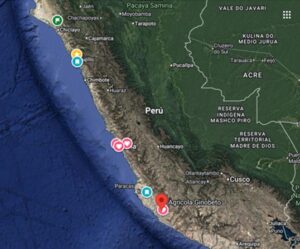
Figure 1: Geographic location of Ginobeto
Coastal agriculture in Peru has faced numerous ecological disasters linked to climate change, overexploitation of groundwater, overuse of pesticides and the destruction of dry forests.
To ensure farming remains sustainable in the region, it is essential to reintegrate native plants and restore biodiversity across the landscape. Doing so supports natural regeneration processes, improves water management, and reduces soil erosion.
The primary aim of these restoration areas is to protect threatened biodiversity and safeguard natural resources by creating and maintaining these vital and unique habitats. These habitats support bees and other pollinators, threatened birds and reptiles, as well as species that naturally regulate pests and disperse seeds – helping to promote wider ecosystem recovery and long-term resilience.
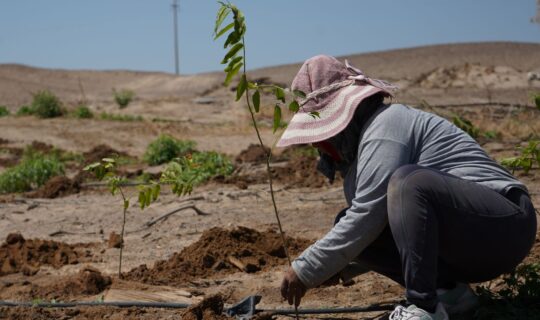
Guided by images which indicate the historical location of vegetation and water ways, The Ginobeto Forest Restoration Project will reintroduce 3,000 native plants to restore the former ecosystem.
The area has perennial groundwater, which, provided it is not over-exploited, should rise sporadically from December to March. This, along with crop moisture combined with night dew and seasonal fog capture, should mean that following the forest establishment, after 3–4 years, irrigation will be required no more than twice a year and eventually the area will become self-sufficient.
Many local species are already highly threatened, and their survival will increasingly depend on developing areas like The Ginobeto Forest Restoration Project. The aim is to establish a permanent conservation area.
Watch this space as we begin to share the stories of these species in their new home.
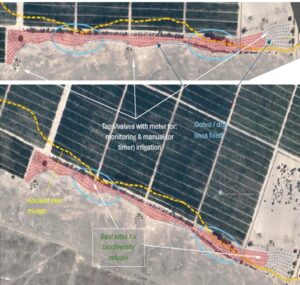
Figure 2: Area designated for forest restoration
Huarango Nature: Protecting native species
Huarango Nature (HN) is a Peruvian non-profit organisation founded in 2017 as a legacy of several conservation projects initiated in Peru in 2001, focused on the identification, propagation, and restoration of native species on the Peruvian coast and in the Andes. Between 2006 and 2009, its founders developed the ‘Huarango Project’ (Kew-Ica) at the Royal Botanic Gardens, Kew (RBG Kew) with support from the Darwin Initiative (Defra, UK).
Its objective is to create, manage, and develop initiatives in:
● Biodiversity conservation
● Habitat restoration
● Agrobiodiversity
● Education and community participation
Huarango Nature is based at Agricola Chapi in Ica, who have supported the project from its inception, and who have a well-established restoration area, which continues to thrive.
The HN nursery has produced around 3,000 native plants of woody perennials for the Ginobeto Forest Restoration Project. These will be planted across a 3.2-hectare strip, helping to restore a unique riparian oasis dry forest in the arid landscape.
The plants represent 31 key tree and shrub species, carefully selected to reflect the region’s natural ecological communities. Together, they will help rebuild desert margin ecosystems and strengthen long-term conservation efforts. Following detailed landscape surveys and seed collection, these locally-sourced species have been chosen for their resilience and adaptability. Just as importantly, they will provide diverse habitats for a wide range of wildlife; from endemic lizards and nightjars to burrowing owls and desert foxes. The restoration approach draws on relict habitats as ecological reference, guiding the recovery of native biodiversity across the landscape. Species selection has also been informed by the Royal Botanic Gardens, Kew herbarium archives, alongside invaluable local knowledge and insights into the historical ecology of the Ica region, which was part of the original Ica habitat restoration project.
These plants, germinated and produced at the HN nursery, come from the seed bank and bulking operation maintained by the nursery. Working with local landowners and supporting local communities, the seeds originate from the same desert region of Ica-Nazca and come from the last relict ecosystems from which the nursery obtains all the germplasm specifically for restoration projects to conserve and rebuild biodiversity.
This project aims to conserve the biodiversity and cultures associated with Huarango (Prosopis (Neltuma)) forests, fostering educational and cultural engagement with the local population. Made up of members of the local community, and knowing that without education there is no conservation (and that no conservation means no education) HN has a strong school outreach programme to promote real engagement amongst children about the importance of native biodiversity and the wide-ranging benefits native species have. This project will extend this even further with the opportunity to show workers, local communities, and other key stakeholders, how these areas can be successfully integrated into commercial farming to deliver wide-scale benefits.
Project status, February 2026
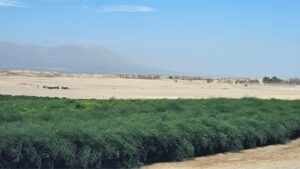
Figure 3: The area at Ginobeto ahead of planting.
Irrigation:
Ginobeto farm is currently in the process of installing the irrigation system for this restoration area, which will be used to establish the plants.
Plant progress in the nursery:
Recently Liliana from our technical team visited the HN nursery to see the progress of the planting and development of the plants designated for the Ginobeto Forest Restoration Project. All of the plants intended for the first planting are now ready for transplanting.
The first planting is estimated to begin in in early 2026 following the completion of the irrigation system.
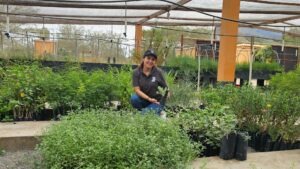
Liliana, Barfoots Latin America Technical Manager with some of the 3,000 plants at the Huarango Nature nursery ahead of planting.